Translate

Featured post

क्षेत्रीय सुरक्षा , शांति और सहयोग की प्रबल संभावना – चीथड़ों में लिपटी पाकिस्तान की राष्ट्रीयत

“ क्षेत्रीय सुरक्षा , शांति और सहयोग की प्रबल संभावना – चीथड़ों में लिपटी पाकिस्तान की राष्ट्रीयत ा “ —गोलोक विहारी राय पिछले कुछ वर्षों...

Saturday, 22 March 2014

Four Chinese Lawyers Detained Over 'Black Jail' Appeal

Four Chinese Lawyers Detained Over 'Black Jail' Appeal

map-Jiamusi.gif
Map showing China's Heilongjiang province's Jiamusi city.
RFA
Authorities in the northeastern Chinese province of Heilongjiang have detained four prominent rightslawyers representing detainees in an unofficialdetention center, or "black jail," fellow lawyers said on Friday.

Jiang Tianyong, Tang Jitian, Wang Cheng, and Zhang Junjie were detained by authorities on Friday morning at their hotel in Heilongjiang's Jiamusi city, Guangzhou-based rights lawyer Li Xiaoling told RFA'sMandarin Service.

The lawyers had been hired by relatives of those held in the "black jail" to campaign for their release, according to Beijing-based rights lawyer Chen Jiangang.

"These four lawyers were representing human rights cases on the front line," Chen said. "They detained them and confiscated their cell phones."

"I have tried to call them several times, but no one is picking up, and I can't get through; there's a switched-off message," he said.

Fellow rights lawyer Zhao Yonglin confirmed the report.

"The situation now is that the four lawyers have been locked up in a detention center, on the grounds that Wang Cheng's lawyer's license is fake," Zhao said.

Threatening call

Zhao said he had received a call from a number listed as belonging to the Jiamusi police chief, threatening that if the black jail case wasn't dropped, the lawyers "would find it hard to practice their profession."

But the caller, who had a northeastern accent, declined to give his name or job title, he said.

Zhao said the lawyers had taken issue with an extrajudicial detention center officially known as a "legal study center," where the authorities send anyone who pursues complaints against them, particularly with higher levels of government.

"There's a place [in Qinglongshan] called the legal study center, where they hold citizens prisoner who haven't committed any crime," Zhao said.

"The four lawyers were detained while on an inspection visit to the Qinglongshan black jail ... the sign on the gate reads Jiansanjiang Rule of Law Education Center," said Zhao, who had planned to join the other four lawyers, but canceled owing to other commitments.

"In fact, it's a black jail."

He said many of the detainees are being held there for religious reasons.

"They have a lot of groups with religious beliefs locked up in there under the guise of legal education," Zhao said, adding, "They hold them for several months at a time, even up to a year."

Hired by relatives

He said the four lawyers had been hired by relatives of detainees to get them out.

"They were there to demand their release, because they were locked up without any legal process at all," Zhao said.

Rights lawyer Chen Jiangang said China's embattled legal profession has been under increasing pressure in recent years.

"There are no human rights in China, and we lawyers have to try to do our jobs in manacles," Chen said. "It's a humiliating business, being a lawyer in China."

"There's no guarantee of one's personal rights or safety, and yet we still try to help others defend their rights," he said.

"We are pretty helpless."

China's parliament voted on Dec. 28, 2013, to end its controversial "re-education through labor," or laojiao, system of administrative punishments following a prolonged campaign by lawyers, former inmates, and rights activists to abolish it.

But rights lawyers say many other forms of extrajudicial detention remain, and that some former laojiao camps have changed their name but not their function.

Torture, abuse

Rights activists in China have long campaigned for the abolition of "black jails," which are often used to detain those who complain to higher levels of government about local officials or to hold anyone regarded as a troublemaker or threat to "social stability."

Those held without due legal process are at increased risk of torture and general abuse, rights groups say.

Staff in such detention facilities often insult and humiliate detainees, and have even robbed, raped, seriously injured, and killed them, according to a report last year by the Chinese rights website Weiquanwang.

In May, Sichuan authorities detained and beat high-profile rights lawyers who tried to visit an unofficial detention center, or "black jail," according to fellow lawyers who spoke with them during the attack.

And according to London-based rights group Amnesty International, thousands of Chinese people are subjected to arbitrary detention in labor camps and unofficial "black jails" each year.

Earlier this month, Beijing announced a rise in the domestic security, or "stability maintenance," budget to 205 billion yuan (U.S. $33 billion).
Read more »

Missing persons case: In a first,Pak govt lodges FIR against army officials

Missing persons case: In a first, Pak govt lodges FIR against army officials

The court also sought a copy of the challan after the investigation, saying it would examine whether action taken against the accused is in accordance with the December 2013 ruling. DESIGN: SIDRAH MOIZ KHAN
ISLAMABAD: 
For the first time in Pakistan’s history, a defence minister on Friday lodged an FIR against some army officials in a case involving illegal removal of 35 undeclared inmates from an internment centre in Malakand who have been listed as ‘missing’ since then.
The case was registered by the Khyber-Pakhtunkhwa police under Section 346 of the Pakistan Penal Code against Naib Subedar Amanullah Baig and others, and the provincial advocate general, Latif Yousufzai, submitted a copy of the FIR before a three-judge bench of theSupreme Court.
On the complaint of Defence Minister Khawaja Muhammad Asif, the K-P government registered a criminal case under Section 346 against the army officials allegedly involved in the illegal removal of 35 undeclared inmates from an internment centre in Malakand.
Section 346 relates to the wrongful, secret confinement of a person. “Whoever wrongfully confines any person in such manner as to indicate an intention that the confinement of such person may not be known to any person interested in the person so confined, or to any public servant, or that the place of such confinement may not be known to or discovered by any such person of public servant as hereinbefore mentioned, shall be punished with imprisonment of either description for a term which may extend to two years in addition to any other punishment to which he may be liable for such wrongful confinement,” the section states.
A senior law officer told The Express Tribune that Section 346 deals with minor offences that are bailable. “The accused has the right to get bail and the court has no power to refuse it. Likewise, the judge is bound to grant bail from the very first day,” he added. He said that since the 35 missing persons have yet to be found, the police could have applied Section 365 of the PPC, which deals with non-bailable offences.
On Wednesday, the SHO of Secretariat police station, Abdul Rehman, while responding to a complaint by Defence Minister Khwaja Asif, referred its report on the lodging of an FIR to the Malakand police under Section 253 of the Police Rules 1934.
“We are confident that if the matter is probed in accordance with the law by the federal and provincial governments, the names of other army officials who were involved in the removal of 35 persons from the internment centre will surface,” the Supreme Court said in its December 10, 2013 judgment.
Defence ministry counsel Raja Irshad said this is the first time in Pakistan’s history that a defence minister has lodged a criminal case against military officials. He added that the attorney general for Pakistan (AGP) could not give the federal government proper legal advice as the government has lodged the case under pressure.
During Friday’s proceedings, the bench expressed satisfaction at the registration of a criminal case and directed the federal and provincial governments to ensure an investigation against the army officials in a transparent manner. The bench, headed by Justice Jawwad S Khawaja, said that if the investigation reveals that other sections of the PPC can be applied, then the FIR should be updated.
The court also sought a copy of the challan after the investigation, saying it would examine whether action taken against the accused is in accordance with the December 2013 ruling.
AGP Salman Aslam Butt told the court that a one-man commission, headed by Justice (retired) Ajman Mian, has commenced a search for the missing persons. The court directed that the commission’s report be submitted within a month.
The AGP, while referring to paragraph 18 of the December 2013 judgment, said that the federal government has promulgated the Protection of Pakistan (Amended) Ordinance 2014 on enforced disappearances.  He stated that the government would put forward further legislation if required.
The case has been adjourned for three weeks.
Read more »

Peace talks: Negotiations with the Taliban without army’s representation to fail, says Fazl

Peace talks: Negotiations with the Taliban without army’s representation to fail, says Fazl

In Pakistan Main Actor is Army and Elected Civilian Government as like his Toy 

JUI-F chief Maulana Fazlur Rehman. PHOTO: AFP
MULTAN: 
“The absence of army representatives in negotiations with the Taliban is part of a plan to launch a military operation,” Jamiat Ulema-i-Islam-Fazl (JUI-F) chief Maulana Fazlur Rehman said on Friday.
Speaking at a press conference at Jamia Qari Hanfia in Multan, he said the peace talks would fail if the army was not included directly.
“The Taliban are ready to negotiate.” Rehman said he had advised Prime Minister Nawaz Sharif to include army in the peace talks by any means necessary.
“The issue with the peace talks is that on one side, there are non-state actors according to our military establishment.
On the other side, there are non-state representatives of the federation… they have no concern, direct or indirect, with the outcome of the negotiations.”
The JUI-F chief said the government had not started the talks on a positive note by using terms like ‘militants’ to refer to the Taliban.
“This will never bring the people of Pakistan together… it will only breed more hatred.”
Rehman said “same state actors” were causing hindrance in peace dialogue as far as the issue of Kashmir was concerned.
“The Kashmir issue is still unresolved as a result of involvement of state establishments which are more powerful than the federations on both sides.
These establishments, on both sides, do not want a political settlement of the Kashmir issue,” he said.
The Jamiat Ulema-i-Islam-Fazl chief said the time was right for the two governments to resolve the Kashmir dispute.
“If the present government does not take measures to resolve it, the issue might never beresolved,” Maulana Fazlur Rehman said.
Read more »

Monday, 17 March 2014

A Terrorist Group Tahreek-e- Taliban Has Became A Parallel Power Before Pak Gov, ISI And Pak Army

Taliban demand 'free peace zone' for peace talks: Maulana Samiul Haq

A Terrorist Group Tahreek-e- Taliban Pakistan(T T P Pak) Has Became A Parallel Power Before Pak Gov, ISI And Pak Army

Maulana Samiul Haq said that the army, FC and law enforcement agencies were still arresting suspected Taliban . PHOTO: FILE
AKORA KHATTAK: Jamiat Ulema Islam (Sami group) chief Maulana Samiul Haq said on Monday that the Tehreek-e-Taliban Pakistan (TTP) wanted a “free peace zone” for the purpose of peace talks in which they can travel without fear of being arrested,  BBC Urdureported.
Haq claimed that the army, FC and law enforcement agencies were still arresting suspected Taliban personnel and security checkposts in various locations were restricting their movement. “Several senior Taliban leaders have to remain hidden because of the fear of being arrested.”
He also said that the whereabouts of Taliban leader Maulana Fazulullah were not known, adding that as many as four members of the Taliban shura may take part in the peace talks process.
The peace talks process between the Taliban and the government entered the next stage of the peace talks process after Taliban committee members met senior Taliban leadership on March 14, 2014.
Read more »

In Desperation, Borei Keila Women Turn to Sex Work After Eviction

In Desperation, Borei Keila Women Turn to Sex Work After Eviction


borei-keila-sex-worker-march-2014.jpg
Bopha waits for customers at a park near the waterfront in Phnom Penh, March 2014.
 RFA
Some women evicted from Phnom Penh’s Borei Keila slum have resorted to prostitution to support themselves after losing their homes and jobs in one of Cambodia’s bitterest land disputes.

The women are among some 150 families struggling to make ends meet since being moved to a barren plot of land an hour-and-a-half’s drive outside the city two years ago after property developer Phanimex reneged on an agreement to provide them with on-site housing in exchange for land in Borei Keila.

With no new jobs in the relocation area, some 50 women in the community have returned to the city to work in bars and karaoke parlors on the fringes of the city’s sex industry, with some of those women turning tricks for a living, according to a community leader.

One of the women, who asked to be identified as Bopha, said that since losing her job as a cleaner at a local market she has had no choice but to work as a prostitute.

"If Phanimex hadn’t evicted us, I wouldn’t have to face this,” she told RFA’s Khmer Service.

"But now I am a prostitute. Phanimex is killing me,” she said.

Violent eviction

Bopha lost her job when her family relocated to Phnom Bat commune in Kandal province, some 35 kilometers from Borei Keila, following a violent forced eviction in 2012.

On Jan. 3 that year, Phanimex workers bulldozed homes belonging to her and some 300 other families, prompting a violent clash in which scores of police fired warning shots and tear gas as residents hurled bricks and Molotov cocktails.

Phanimex was demolishing the homes to make way for new offices, retail, and apartments in the area after failing to honor an agreement to build new housing for some of the Borei Keila residents on part of the land.  Some evictees were moved to Phnom Bat, while others remain in limbo.

Bopha was pregnant during the clash and says she miscarried after security guards overseeing the forced eviction beat her while she was trying to protect her two children.

The sewing machine she used to earn extra income tailoring clothes was destroyed in the demolition along with the family’s home.

In the resettlement area in Phnom Bat, a barren plot of land with nothing surrounding it, the family had no way to make a living, Bopha said.

Like dozens of other families, they moved back to Borei Keila to live in a garbage-strewn alley of makeshift tents and shelters along with residents who were never relocated to new housing—but without Bopha’s husband, whom she divorced after starting to work as a prostitute.

Soliciting customers

One night this month after dark, Bopha headed from Borei Keila to a park near the riverfront to look for customers.

“Are you waiting for someone to spend the night with?” she asked a man lingering in the park.

At the same time of night two years ago, she would have been asleep at home with her husband and children, she told RFA’s Khmer Service.

"I sit in parks waiting for customers. I’m so ashamed,” she said.

Bopha said she earns about U.S. $20 from each customer, which she uses to support her two children and mother and pay off the family’s debts.

"My mother owes people money, I can't ignore it," she said.

One of many


Bopha is one of many Borei Keila woman with no choice but prostitution, community representative Chhay Kimhorn said.

Some 50 of them have taken up work in the entertainment industry, and some of them have resorted to prostitution like Bopha, she said.

“I myself am now working as a scavenger, but if I weren’t able to make ends meet anymore I would become a prostitute too to support myself,” she said. 
cambodia-borei-keila-kids-march-2014-400.jpg
Children play in front of homes at the resettlement site in Phnom Bat, March 2014. Photo credit: RFA.
Bopha said her two sisters, also from Borei Keila, are working in the entertainment industry, and she has asked them not to sell their bodies. 

No opportunities

Phnom Bat commune representative Touch Khorn, said that with no employment opportunities and poor conditions in the new settlement, many of the Borei Keila women were in a similar predicament to Bopha.

“Some women have been left with no choice but to work as prostitutes, or to cut their hair and sell it,” he said.

Most of the 100 people who have remained in Phnom Bat are surviving on donations from NGOs, he said.

The families have no electricity, no health care, and not enough land to cultivate any crops, and the children have to walk some 4 miles (6 kilometers) to reach the nearest school, he said.

Long-running dispute


Borei Keila residents, along with evictees from Boeung Kak and Thmor Koul elsewhere in the city, have staged regular protests against their eviction, some of them resulting in residents being arrested or violently beaten by police.

Phanimex originally agreed more than a decade ago to construct 10 buildings to house 1,776 families in Borei Keila, in exchange for license to build a new property on 2.6 hectares (6.4 acres) of the land.

But only eight of the buildings have been built so far.

In January this year, Phnom Penh governor Pa Socheatvong visited those living in the makeshift shelters in Borei Keila, promising new temporary houses will be built.

Residents say they want a permanent resolution to the problem.

In February, police raided an unfinished apartment building in Borei Keila that community members excluded from the resettlement agreement had occupied for two days.

'Voluntarily'

Asked about Bopha’s case, Phnom Penh City Hall Spokesman Long Dymong said her involvement in sex work was not the fault of the forced eviction.

“Some women do the work voluntarily,” he told RFA.

Bopha said she wanted Phanimex to find a long-term solution for the residents that would not relegate them to poverty.

“The company should resolve the dispute.  They shouldn’t allow others to live in poverty any longer and end up as prostitutes.” 
Read more »

'They Gave Journalists a Line They Mustn't Cross'

'They Gave Journalists a Line They Mustn't Cross'


china-gao-yu-2007.jpg
A file of Chinese journalist Gao Yu speaking at a press conference in Hong Kong.
 AFP
Reporters attending the debut news conference of Chinese premier Li Keqiang at the close of the National People's Congress in Beijing this week were warned that they would be blacklisted if they asked about the widening investigation into relatives and political allies of former security czar Zhou Yongkang. Hong Kong's English-language South China Morning Post newspaper said reporters were told by officials they would be unable to ask questions at future events if they asked the premier about Zhou. 

Veteran Beijing political journalist Gao Yu told RFA's Mandarin Service that the move had a chilling effect on a usually lively event:

This looks as if it came from central government. They don't want a single question that crosses any boundaries. This sort of control over public expression seems to me much stricter than [the previous administration under president Hu Jintao and premier Wen Jiabao].

People usually have high hopes of premier's news conference at the end of the parliamentary sessions. Now that they've been warned off, journalists will be even more curious. But foreign journalists also need a work permit to work in China. Recently, the New York Times crossed a line [in reporting assets linked to former premier Wen Jiabao] and they won't even give out visas to a lot of their journalists. So they need to be realistic on this matter.
china-li-keqiang-presser-march-2014.jpg
Chinese Premier Li Keqiang speaks at a press conference at the Great Hall of the People in Beijing on March 13, 2014. Photo credit: AFP.
No one asked [about Zhou] because they gave journalists a line which they mustn't cross. There was none of the usual liveliness in trying to ask questions, or asking additional questions [that we used to see].

There is a very fierce power struggle going on behind the scenes at the moment. The most important issue right now is about when they can wrap up the Zhou case; about how soon the Politburo standing committee can cross this line.

My own analysis is that the old guard, former standing committee members, aren't 100 percent sure about [the Zhou investigation], with at least 90 percent of them maintaining that [investigating a former standing committee member] is a line which can't be crossed, otherwise everyone would feel insecure all the time.

They think it's all right to deal with Zhou Yongkang behind closed doors, even to the point of expelling him from the party. But it should have nothing to do with criminal law, and shouldn't go to trial in the judicial system.

So, in future, if this gets announced, it could be as the result of a party investigation only. If there is a real breakthrough; if both Zhou Yongkang and [jailed former Chongqing party chief] Bo Xilai appear in open court, that will indicate a victory for [President] Xi Jinping.
Read more »

Saturday, 1 March 2014

Liberal newspaper Express Tribune cowed into silence by Pakistani Taliban

Liberal newspaper Express Tribune cowed into silence by Pakistani Taliban

Media Group -opts for self-censorship on terrorism after Taliban admits murder of three employees for critical reports on militants.

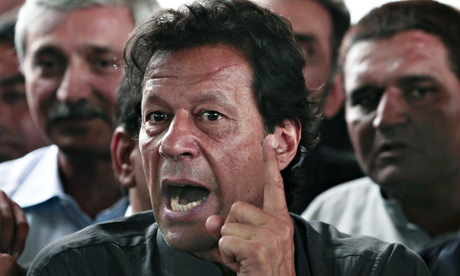
Imran Khan speaks to the media after appearing before the Supreme Court in Islamabad
Imran Khan, former cricketer and head of Tehrik-e-Insaf, which is spared criticism because it opposes attacks on the Pakistani Taliban. Photo: Faisal Mahmood/Reuters
When it was launched four years ago, the Express Tribune set out to become the house newspaper of liberal-minded Pakistanis.
A newcomer to a market dominated by conservative-inclined papers, it made a point of writing about everything from the relentless rise of religious extremism to gay rights.
But in recent weeks the paper has been cowed into silence by an unusually blatant display of power by the Pakistani Taliban.
The paper was forced to drastically tone down its coverage last month after three employees of the media group, which includes another newspaper and television channel, were killed in Karachi by men armed with pistols and silencers on 17 January.
The attack was later claimed by the Tehrik-e-Taliban Pakistan (TTP), a large coalition of militant groups, which accused the media group of disseminating anti-Taliban propaganda.
Immediately following the killings, the paper's editor, Kamal Siddiqi, sent an email to staff outlining the paper's new policy.
Henceforth there would be "nothing against any militant organisationand its allies like the Jamaat-e-Islami, religious parties and the Tehrik-e-Insaf", the rightwing party led by Imran Khan, that strongly opposesmilitary operations against the TTP.
There would also be "nothing on condemning any terrorist attack", "nothing against TTP or its statements" and "no opinion piece/cartoonon terrorism, militancy, the military, military operations, terror attacks".
Reporters have been banned from describing a movement responsible for the deaths of thousands of civilians, soldiers and police as "outlawed" or "militant".
The terrorist attacks that rack the country on an almost daily basis are covered on the news pages, but are pared down.
"We do have exclusives, but we don't run them," Siddiqi said. "It's very frustrating at a personal level for all journalists. But we have decided that we won't do anything at least for the foreseeable future that will come back to haunt us."
Other changes include a more conservative approach to photographs offemale models in the paper's lifestyle sections and weekend magazine.
Worst affected are the opinion pages. Once-feisty leader writers have almost entirely overlooked the near-continuous attacks that have rocked the country in recent weeks.
Ayesha Siddiqa, a regular columnist, said the muzzling of Pakistan's media was contributing to an "absolutely mesmerising information deficit" among the public.
"I said to the editor, 'what am I to do, start writing about cooking or films?' Because that's all that's left."
The killings followed a bomb and small-arms attack on the company's offices in Karachi in December. One reporter on the paper said the attacks had terrified many colleagues.
"The paper has an unusually young staff and a lot of the kids were pretty scared, with parents telling them they should quit," the staff writer said. "There were some people who said we should fight back, but they were a minority."
After the killings, a TTP spokesman, Ehsanullah Ehsan, was allowed to join by telephone a live discussion programme on the paper's sister television station, Express News.
He claimed responsibility for the killings, complained the company "was playing the role of propagandist in this war with the Taliban" and said it had ignored regular complaints he had emailed to the channel.
The TV show's host, Javed Chaudhry, promised that the station and newspaper would take pains to present the TTP's position "without any trimming".
"We will have a balanced and impartial attitude towards you and will convey your point of view to the people but we have only one request: that our colleagues should be protected," he told the TTP spokesman and watching audience.
The TTP has threatened and attacked journalists in the past, including the BBC after its Urdu-language service aired highly critical comment about the Taliban attempt to assassinate the schoolgirl Malala Yousafzaiin 2012.
Although much of Pakistan's national debate is conducted in the country's generally right-leaning Urdu press and television, the TTP monitors everything.
Ali Dayan Hasan, of Human Rights Watch, said: "The Taliban and other armed groups have threatened the media over their coverage for several years, but now those threats are ratcheting up by accompanying attacks.
"It's an extremely effective tactic that does far more than just censorship, it also skews the entire national debate."
Siddiqi, the editor, said he could not risk any more lives.
"The fact is three people have been killed and no one out there is protecting us," he said, pointing out that no arrests had been made in connection with either of the attacks on the company.
"We are on our own. We have to look out for our own people."
Read more »